
Why Your Toddler Climbs Everything — and What to Do About It

You turn around for thirty seconds and your two-year-old is on top of the kitchen counter. The sofa back is permanently dented. The bookshelf is no longer trustworthy. Most parents of toddlers have lived this — and many of them have wondered, at some point, whether their child is unusually badly behaved or just developmentally normal.
The honest answer: kids love to climb because climbing is a natural part of early development. It's not naughtiness, and it's not boredom. For many children, the urge to climb is especially strong in the toddler and early preschool years. The US Centers for Disease Control and Prevention (CDC) lists climbing on and off a couch or chair without help among the typical milestones by 18 months. The question isn't how to stop a toddler from climbing — it's where to channel it.
In this guide: why toddlers climb everything, why suppressing it backfires, and how to set up a safer climbing space at home so that the bookshelves can stay where they are.
At a glance
- When: for many children, the climbing urge is strongest in the toddler and early preschool years
- Why they climb: natural need for movement, vestibular input and gross motor practice
- What rarely works: trying to stop climbing entirely
- What helps: a "yes space" with a safe place to climb, plus clear rules about everything else
- Realistic setup: a Pikler triangle for toddlers; a small climbing frame for preschoolers
Why Do Toddlers Climb Everything?
Climbing isn't a single skill. It's a coordination puzzle that uses arms, legs, core and brain at the same time. For a two-year-old, it's a challenge that fits their stage of development well.
A few of the things happening every time your child scales the side of the armchair:
Gross motor development. Climbing gets the core, grip and leg muscles working together, with opposite arm and opposite leg moving in sync.
Spatial awareness. Where is my body in space? Where's the next handhold? Can my foot reach that ledge? Regular climbing gives children plenty of chances to practise exactly that — on playgrounds, stairs and woodland paths too.
Risk competence. This one matters and is widely misunderstood. Climbing lets children practise assessing risk: I can manage this height versus this is too far. Norwegian researchers Ellen Beate Hansen Sandseter and Leif Edward Ottesen Kennair describe climbing as the most frequent form of play at great heights — one of six categories of so-called risky play, which they see as part of normal development. Their argument (a theoretical paper, not a measurement study) is that such play can help children gradually learn to cope with height and fear. Children with fewer chances to practise safe climbing may have fewer opportunities to build that judgement.
Vestibular input. Climbing involves head position changes, height and shifting balance — input for the vestibular system, the body's sense of balance (see our piece on indoor swings for kids for more on this).
Problem-solving. Climbing is problem-solving. Where do I grip? In what order? What if my left hand goes there instead?
In short: when your toddler scales the bookshelf, their body is asking for something legitimate. The bookshelf just happens to be the closest answer.
Why Trying to Stop Climbing Completely Often Backfires
The intuitive parent move is "no climbing" — said firmly, sometimes accompanied by lifting the child down. This works for about ninety seconds. Then the child finds the next surface.
There's a reason. For many toddlers, the climbing drive feels powerful and very hard to ignore. A two-year-old is not climbing the sofa because they're naughty; they're climbing it because their body is asking for movement. According to WHO recommendations, children aged 1 to 4 should spend at least 180 minutes a day in a variety of physical activities, spread throughout the day — for 3- to 4-year-olds, at least 60 minutes of that at moderate-to-vigorous intensity.
Three things go wrong when parents try to stop climbing entirely:
1. The child climbs anyway, just less safely. When climbing is forbidden, children climb when adults aren't looking — typically in worse spots and without a soft floor.
2. You're saying "no" all day. Constant prohibition is exhausting for both of you. It also dulls the meaning of "no" for situations that genuinely need it.
3. Risk competence has little room to develop. A child who has had few chances to climb in a safer setting has had less practice. On their first real climb at the playground, they often lack the experience that low, supervised climbing can build.
What usually helps more is a small shift: stop fighting the climbing drive and redirect it.
The "Yes Space" Approach
A yes space is a small area of the home where your child can climb, jump, hang and explore under your supervision — without being told no at every move. Outside the yes space, normal house rules apply: the bookshelf is not for climbing, the kitchen counter is off limits.
Two things make this work:
The yes space has to be genuinely satisfying. A boring climbing setup gets ignored; a good one absorbs a lot of climbing energy.
The off-limits stuff has to actually be enforced. The deal is: yes here, no there. Both halves matter.

Does your child mainly want to get onto the kitchen counter because they want to see what you’re doing there? A learning tower can help: it brings your child up to worktop height while you stay right next to them. The Manu learning tower & growing chair 2in1 has side armrests that give children up to 15 kg extra hold, and it doubles as a growing children’s chair.
How to Create a Climbing Space at Home
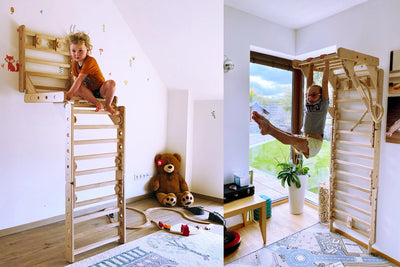
You don't need a separate playroom. A Pikler triangle needs little floor space — the Loopo Small Pikler Triangle T2, for example, about 97 × 60 cm. Add the free space around it; in many homes, part of the children's room or living room is enough.
The basics:
- A climbing structure with rungs at toddler-friendly heights
- A suitable, non-slip fall protection mat matched to the fall height under and around it (an ordinary rug does not replace it)
- Enough free space: plan at least 1 m of clear space around the climbing frame, so your child doesn't hit furniture or edges when jumping off
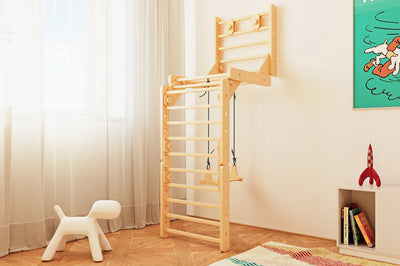
- A second element — a swing, a slide or an overhang — adds variety as the child grows (on mounting a swing safely: how to mount an indoor swing in the kids' room)
What a good setup can look like by age:
| Age | Possible setup | What it offers |
|---|---|---|
| 10–18 months | Low Pikler triangle | Pulling up, first standing |
| 18 months – 3 years | Pikler triangle + slide; small bridge | Real climbing, controlled descent |
| 3–5 years | Wall bars, climbing frame with overhang or pull-up bar | Strength, hanging, swinging |
| 5+ years | Modular climbing system; multiple elements | Full-body movement, longer challenges |
These ages are a guide. What counts is the recommended age the manufacturer gives for each product and each setup — at Loopo, it starts at 10 months.
Three Loopo Playsets fit these stages.
Loopo Playsets for a Dedicated Climbing Space
For the youngest climbers, the Loopo Froggie 2-in-1 is the classic starting point — a Pikler triangle for children from 10 months that can be built two ways: taller and narrower, or lower and wider. It can be expanded later with additional Loopo parts.
The Loopo Cliff 7-in-1 (recommended for ages 2–10 on the product page) adds an overhang: your child first climbs straight up, then moves across a section that juts out into the room — which asks much more of their arms. It suits preschoolers who have outgrown a simple Pikler triangle.
The Loopo Mini Gym 5-in-1 (recommended from 3 years on the product page) builds into five setups, including wall bars and wall bars with a pull-up bar. These two are fixed to the wall and save floor space; the other setups stand freely. It gives older children a stable, deliberate place to climb.
What all three share: untreated beech wood, modular design, and a structure made for everyday movement at home.
More reading: Our complete guide on when a Pikler triangle is right for your child covers age suitability in detail.
Common Worries — Plainly Answered
"My toddler climbs everything — is that normal?" Yes, it's very common in toddlers. The climbing urge is often especially strong in the toddler and early preschool years. Over time other interests develop, and climbing on furniture usually becomes less frequent.
"I'm scared they'll fall." Low-height climbing over a suitable fall protection mat gives children a more controlled way to practise balance, body awareness and judgement. The bigger worry is often unexpected climbing on furniture not designed for it — the back of the sofa, the kitchen counter — onto hard floors. A dedicated climbing setup can be a safer alternative to climbing furniture that was never designed for it.
"What if they still climb the bookshelf?" Then it takes patience: enforce the off-limits rule consistently for a few weeks and point to the climbing space each time. The more inviting the setup, the sooner it becomes the first choice. Either way, tall shelves should be anchored to the wall.
"Are some children just more 'climby' than others?" Yes. Children differ in how much vestibular and proprioceptive input they need. A child who climbs more may simply need more movement input — it doesn't mean something is wrong.
Practical Setup — Where to Start This Week
If you're looking at a 2- or 3-year-old who climbs everything, a sensible starting setup is:
- A Pikler triangle or small climbing frame with rungs at toddler height
- A suitable fall protection mat under and around it
- A clear "no climbing" rule for the bookshelf, sofa back, kitchen counter
- A bit of patience for the transition — the new rules take a few weeks to settle
The goal: the bookshelf gets climbed less, the dedicated setup gets used more, and the daily "stop climbing!" goes from a constant refrain to a rare exception.
The climbing instinct doesn't go away. It just goes somewhere it belongs.
Frequently Asked Questions (FAQ)
At what age do children stop climbing on furniture? There's no fixed age. For many children, unplanned climbing on furniture becomes less frequent during the preschool years. Many still love to climb regularly at school age, but with better judgement about where climbing is appropriate.
Is climbing suitable for a 1-year-old? Supervised climbing on a low Pikler triangle can be — at Loopo from 10 months (Loopo Froggie), and once the child can pull up to standing on their own. The first months are mostly pulling up, not climbing height.
My child only climbs me — does that count? Climbing on a parent is normal and good — it's both physical contact and gross motor work. A dedicated climbing setup adds variety; it doesn't replace the climbing-on-parent stage.
Should I help them climb higher? In the Pikler approach, the child climbs as high as they can get on their own. Don't lift them onto a higher rung than they can reach themselves — from a place they couldn't reach independently, they often can't climb back down safely either.
What if my child has no interest in climbing? Some children climb less than others, and that's normal. If your child shows little interest, don't push it; balancing, swinging, jumping, running and rolling all offer varied movement experiences too.
How much space do I need for a toddler climbing setup? A Pikler triangle needs little floor space — the Loopo Small Pikler Triangle T2 about 97 × 60 cm — plus at least 1 m of free space around it. Wall bars fixed to the wall barely stick out into the room (Loopo Wall Bars: 10 cm deep). See our home playground guide for larger setups.
Can my child use the climbing setup unsupervised? No. According to the safety notice, Loopo climbing playsets should only be used under the direct supervision of an adult. Supervision doesn't mean correcting every move — it means being close by and watching. Always keep the fall protection mat in place.
Sources
- Centers for Disease Control and Prevention (CDC): Milestones by 18 Months (milestone "Climbs on and off a couch or chair without help")
- World Health Organization (WHO): To grow up healthy, children need to sit less and play more (24 April 2019) and Guidelines on physical activity, sedentary behaviour and sleep for children under 5 years of age (2019)
- Sandseter, E. B. H. & Kennair, L. E. O. (2011): Children's Risky Play from an Evolutionary Perspective: The Anti-Phobic Effects of Thrilling Experiences. Evolutionary Psychology 9(2), 257–284